

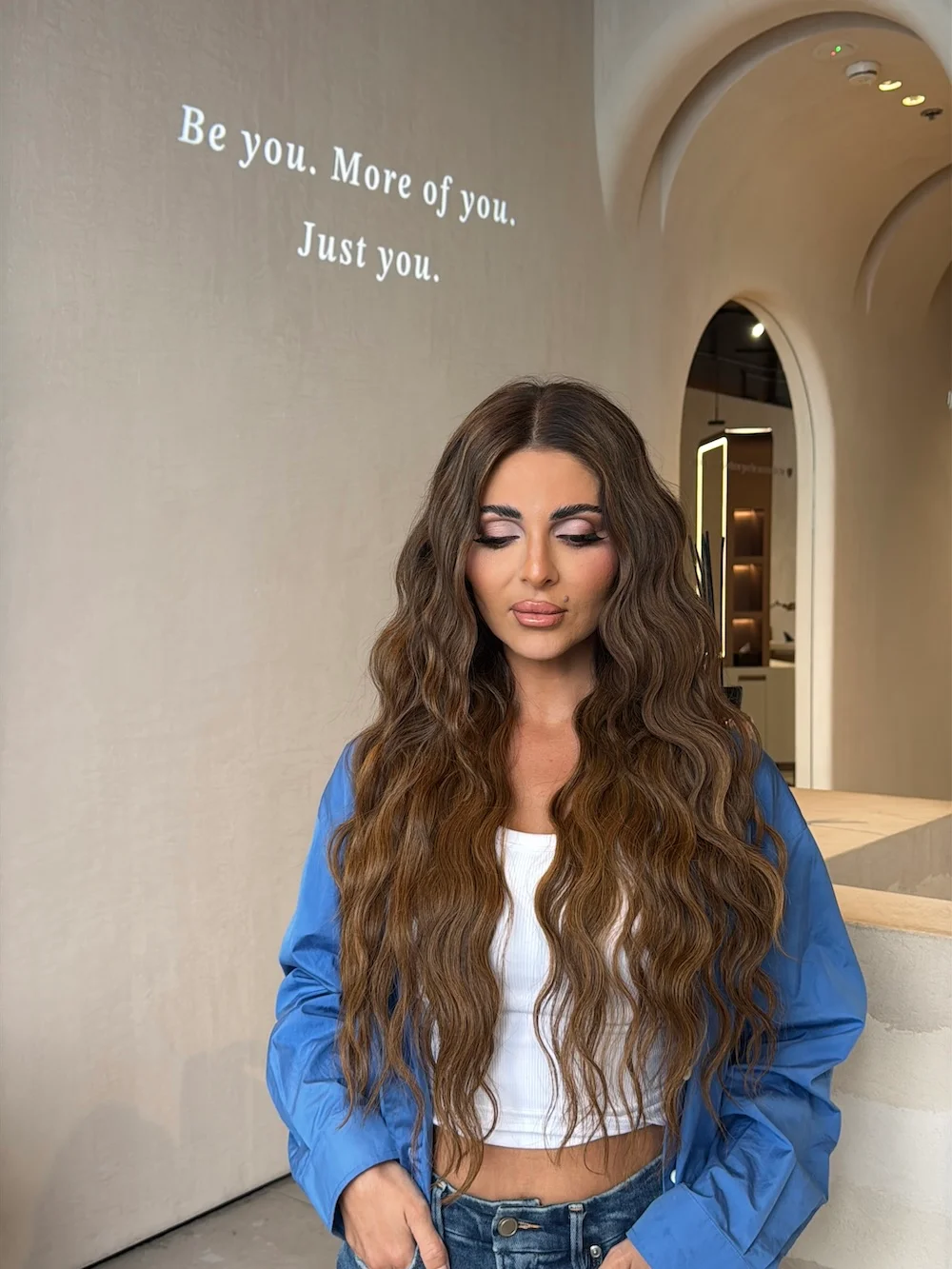
Most people looking for a curly hair salon in Dubai already know generalist stylists tend to get curls wrong. What’s less well known is that “curly hair” isn’t one category – it’s a spectrum, and knowing where your pattern sits on it changes almost everything about how it should be cut, styled and cared for.
The Hair Typing System, Briefly
The most widely used classification splits hair into four broad types – 1 (straight), 2 (wavy), 3 (curly) and 4 (coily) – with each further split into A, B and C to reflect how tight or loose the pattern is. It’s not a perfect science, and most heads have more than one pattern across different areas, but it’s a genuinely useful starting point for figuring out what your hair actually needs.
Type 2: Wavy (2A–2C)
- 2A – loose, barely-there S-waves, often fall flat without some texture product. Easily weighed down by heavy oils or creams.
- 2B – more defined waves starting mid-length, some frizz around the crown. Benefits from a lightweight curl cream rather than gel.
- 2C – well-defined waves bordering on loose curls, thicker strands, more prone to frizz in humidity. Usually needs a stronger hold product than 2A or 2B.
Type 3: Curly (3A–3C)
- 3A – loose, springy ringlets about the width of a piece of chalk. Prone to losing definition by midday without the right product.
- 3B – tighter, bouncier curls, more volume, higher shrinkage between wet and dry length. Needs consistent moisture to avoid frizz.
- 3C – tight corkscrew curls, densely packed, significant shrinkage. Very prone to dryness at the ends since oils struggle to travel down the curl shaft.
Type 4: Coily (4A–4C)
- 4A – tightly coiled, well-defined S-pattern when stretched. Needs regular deep conditioning to prevent breakage.
- 4B – sharper angles in the pattern (more Z-shaped than S-shaped), significant shrinkage, higher risk of dryness.
- 4C – tightest pattern, minimal visible definition unstretched, the most shrinkage and the most moisture-dependent of all the types. Cutting technique matters enormously here, since the true length is easy to misjudge dry.
Why This Matters More Than the Cut Itself
A stylist who knows your type will adjust three things specifically: how they cut it (dry vs wet, curl-by-curl vs sectioned), what products they recommend (gel-based hold for looser types, cream-based moisture for tighter types), and how they explain your wash routine. This is a big part of why generalist cuts on tighter curl types (3C–4C especially) so often disappoint – a technique built for 2A waves simply doesn’t translate.
Curl Type and color
If you’re also considering color, the curl pattern affects how it reads once dry. Hand-painted techniques like balayage tend to work beautifully across most curl types because the placement naturally follows the curl’s movement – very different from foiled highlights, which can look striped once tighter patterns spring up. Mention your curl type to your colorist before any placement decisions are made.
Finding Your Curl Specialist in Al Quoz
Kimia Salon is a ladies-only curly hair salon in Al Quoz offering precision cuts shaped to your actual curl pattern, not a generic template, alongside anti-frizz and Tender Loving Care treatments for hair that’s dealing with Dubai’s humidity, hard water, or general heat-styling wear. Every consultation starts with an honest look at your curl type – and your curl history – before a single snip happens.
Ready for a cut that respects your pattern, whatever it is? Book your curly cut at Kimia Salon or message the team on WhatsApp at +971 4 220 1521.
FAQs
Can I have more than one curl type on my head?
Yes – this is extremely common. Many people have a looser pattern at the crown and a tighter one underneath, or different textures at the nape versus the front. A specialist cuts to the pattern in each section rather than assuming uniformity.
Does curl type change over time?
It can. Hormonal changes, heat damage, and even certain hair treatments can loosen or alter how a curl pattern behaves. If your curls suddenly feel different from a year ago, that’s worth mentioning at your next consultation.
Should I get my hair cut wet or dry if it’s curly?
It depends on the pattern. Looser waves (2A–2B) are often fine cut damp, while tighter curl and coil types (3B and up) are frequently best assessed dry, or dried in sections mid-cut, so the stylist can see exactly how each curl falls before trimming.
What’s the biggest mistake people make with curly hair care?
Over-washing. Stripping natural oils too frequently is one of the fastest ways to lose curl definition and increase frizz, regardless of type. Spacing out wash days and using a sulphate-free shampoo helps almost every curl pattern.
